Magic Mirror Gate
by Cynthia Marie Hoffman
When I was a child in the 80s, I was two children at once. One of me was the real-world version that everyone saw on the outside, and the other one of me was the dreamer. Except that my dreams were nightmares. And my nightmares happened during the day.
In the 1984 movie The NeverEnding Story, the child warrior of Fantasia, Atreyu, finds himself in a white-out blizzard. He stumbles against the winds and swirling snow when ahead, a mirror appears, big and round as the mouth of a cave.
It is the Magic Mirror Gate. To pass through, the warrior must face his “true self.” At first, Atreyu sees his own reflection. But the longer he stares, the more his reflection fades to reveal the face of another boy looking back at him. It is Bastian, an earthing child, inhabitant of the ordinary world. The orchestral soundtrack builds to intensity as they stare—one child bound to the world of imagination, another child bound to keep his feet on the ground—both bewildered that the other could exist inside themselves.
In early 1985, when I was turning 10, the VHS home video of The NeverEnding Story had been out long enough that I’d memorized every line of dialogue. I sat for hours on the orange shag carpet in front of the basement television, watching and rewinding and watching again and building up a crush on the main character, the long-haired 12-year-old boy who was on a quest to save his world.
Together, Atreyu and I fought the Nothing, which is the emptiness that comes when people forget their hopes and dreams. I matched the subtle timbre and intonation of the actor Noah Hathaway’s voice. When he faced the werewolf with a makeshift dagger in hand, we shouted together, “I’d rather die fighting!” with a bravery I could only imagine one day originating from my true self.
When Atreyu’s gray horse lowered beneath the waterline of the Swamps of Sadness, I matched the boy’s urgent tone. “Artax,” we shouted, “you’re sinking!” And there was something achingly familiar in the quiver of panic I heard. It was a kind of panic I often felt but couldn’t say out loud in words of my own. Not yet.
The panic I felt was because of the nightmares (or were they daymares if I saw them during the day?). I had a vivid imagination but very little control over what that imagination showed me and when. I saw car crashes, the house bursting into flames, the silver barrel of a gun about to execute a drive-by shooting every time a car sped past my court.
But at the same time, I also saw the world as it was—traffic rolling uneventfully down the hill in our safe suburban neighborhood, my sister bringing her pet bunny into the yard, seemingly unaware of the risk that our house might explode. This is the real world, I told myself. And whatever my imagination was trying to make me fear? That part wasn’t real.
It felt real, in the way my heart pounded and my limbs zapped with adrenaline all the way to my fingers and toes when I saw a daymare. But it wasn’t real real.
And it wasn’t the kind of thing the kids talked about, so I had to keep quiet. I had one foot in my own version of Fantasia and one foot on the ground in the real world. I was a living version of the Magic Mirror Gate, myself staring bewildered at myself.
***
By the time I was in high school, I had taken an interest in guitar and was entertaining a different kind of fantasy. I was going to be a famous rock star in a heavy metal band with my best friend, Sheesh.
She was my best friend and my mirror reflection. We had a secret language in which both our names were “Sheesh.” We worked the same shifts at Baskin-Robbins and got reprimanded for laughing too much while baking and rolling waffle cones. Once, a grocery store security guard followed us into the parking lot because our behavior had raised an alarm. Our crime? We’d seen a news feature on blue bananas and had searched for them in the produce section, inexplicably dissolving yet again into hysterical laughter. We must have been insufferable to be around.
Together, we idolized the glam metal hair bands of the late 80s and early 90s—Poison, Warrant, Cinderella, Faster Pussycat, Skid Row. My first rock concert was Mötley Crüe. I used my ice-cream-scooping money to buy a t-shirt that my mother wouldn’t let me wear to school—skull and crossbones, and the four bandmates with teased hair and lipstick, strapped into straightjackets. Within a couple years’ time, I had amassed a dresser drawer full of forbidden band shirts.
Glam metal lyrics were raunchy, hedonistic, and sexist. But Sheesh and I weren’t concerned with that part of the music. When Mötley Crüe sang to the “Girls, Girls, Girls” who were sweet to eat but were best when you’re off your feet, we didn’t think they were singing about us. We weren’t vying for a spot backstage; we were vying for a spot on stage.
My dream of rock stardom might have been pure fantasy, but it felt as real in my body as the panic, which still often zinged beneath the surface of my skin. But with this dream, I had full control. I could think about being a rock star whenever I wanted to. And when I imagined clomping my Doc Martens across the stage, I could feel the steel scaffolding shift beneath me. I could feel the heat of the pyrotechnics lighting up my cheeks. And the roiling sea of faces looking up at me.
On both sides of the Magic Mirror Gate, one thing seemed as possible as the next. The real world slogged along with its homework and grades. But it was also possible that an airplane could crash through the roof. The school could explode from beneath my feet. And Sheesh and I could make it big in music.
Why not? We took electric guitar lessons at the music store beside the ice cream shop. We sat side-by-side in music theory class. We earned first and second chair on classical guitar in the high school performance ensemble. Although we didn’t yet have a name for our two-person band, or any songs, we did have notebooks full of poems that could have been song lyrics. That wasn’t nothing.
It was around this time that my older sister, who had only recently graduated from the same high school where Sheesh and I remained, started saying things to us like, “Just wait till you’re in the real world,” and “You don’t know anything about the real world.”
But what did my sister know about the real world that Sheesh and I didn’t? We didn’t have the internet. And she didn’t even pay attention to the glam metal scene. But the way she said it made the world I was living in sound fake and the real world, whatever part of it she was privy to, sound like a disappointment. What she meant was we’d never be rock stars, so quit dreaming.
***
When I was 10, I decided that The NeverEnding Story was such a good movie that it ought to also be a book. So I set myself the task of writing one. In the evenings after school, I sat at the hulking box of a computer in my parents’ bedroom, typing detailed descriptions of the movie from memory, breaking only to run down two flights of stairs to check the VHS again if I’d forgotten a line of dialogue. Every few nights, the dot matrix printer buzzed back and forth across the continuous feed paper, lengthening the path on which I imagined I was walking, inch by inch, toward my future as a writer. I was really doing something.
“You know there’s already a book,” my father said one night, “that the movie is based on?”
No. I did not know that. No one had told me. I hadn’t stumbled upon the book in the elementary school library. It would be years before I’d read on Wikipedia that author Michael Ende had called my favorite movie a “gigantic melodrama of kitsch,” sued the producers, and refused to be named in the credits. But in that moment, it only took a single truth about the real world, glimpsed through a door held open by my father, to realize my toiling at the keyboard was all for nothing.
“Yeah,” I lied. “I knew that.” My cheeks burned. I was mortified for having dreamed so foolishly.
In the land of Fantasia (or Fantastica as it’s called in the book) there’s a giant turtle who lives in the swamps named Morla, the Ancient One (or, as she’s called in the book, the Aged One). “Nothing is real,” she groans. “Nothing matters.”
I had groaned those words along with her in my basement in front of the TV, but I hadn’t known what they meant. Is that what it meant to grow old and give up on your dreams? Was that my future I had tasted at just ten years old?
I hid the pages in a drawer and never opened the computer file again.
***
Senior year of high school, Sheesh and I often went to see our favorite local pop rock band. The shows were all-ages. At the door, we got X’s marked on the backs of our hands in fat black Sharpie, and we sat cross-legged on the floor directly in front of the stage, which was nothing more than a carpeted platform where the band squeezed together with their instruments. We sat like kids in front of the television.
We felt safe. Sheesh and I were surrounded by other teens in the small crowd of regular floor-sitters, too young to mingle with the over-21 crowd who played pool at the back of the bar. They were shadowy figures, mysterious, a glimpse of who we might become.
What we didn’t know was that the Nothing was coming for us. Our favorite local band would never make it MTV big, not for not trying. Sheesh and I would never make it into a band at all.
Grunge had already arrived. Dial-up internet was on our doorstep. And in a few years’ time, Sheesh and I would part ways in one of the biggest heartbreaks of my life. But we would grow up, as all children do, and eventually we would realize we were not each other’s mirror reflections. We had different dreams.
***
In 2026, I am 51 years old, not a rock star but a wife and a mother and an author. I am scrolling on social media late one night on the couch when I encounter a curious factoid: the voice of child actor Noah Hathaway, star of The NeverEnding Story, was re-recorded in the studio with the voice of another actor. The boy I saw on screen, whose voice I thought I’d memorized and recited and shouted with in unison, was not whose voice I heard.
The walls of the living room go staticky, like the very atoms of reality are shaking loose. It’s that big. I share the post to my stories with the text, “My entire childhood was a lie!”
But of course it was. Because what my sister couldn’t have known, when she told me I didn’t know anything about the real world, was that I was already well practiced in discerning the difference between what was real and what wasn’t. From a very young age, because of my secret panic and the nightmares I saw during the day, I had dealt with a daily collision of fantasy-versus-reality. Parsing it was how I survived.
I was well enough aware that Hathaway was an actor playing a child warrior in a fantasy world that was built on the hopes and dreams of humans. And maybe the Ancient One was right: nothing was real. By the end of the movie, Atreyu’s horse sprang back to life and galloped through the field like nothing bad had happened, as if he’d never drowned in the Swamps of Sadness, just like all the nightmare things I had seen as a child, and still see to this day, never actually happened.
But the nightmare-daymare-dreams turned out to be something very real: symptoms of obsessive-compulsive disorder (OCD). And it took me several decades to understand that the best way to control them is to not control them at all. I don’t know if they’re fully on one side of the Magic Mirror Gate or the other, but I suspect they live in both my selves. I’ve faced my reflection and passed through the gate that led me closer to my true self.
And ultimately, I started to write about it, so all those nights I sat at the keyboard typing my own version of a script to The NeverEnding Story were not for nothing. The work of describing someone else’s fantasy world was an early rehearsal for describing my own.
***
One late night in 2019, I unwittingly watched The Dirt, a debaucherous movie about the debaucherous lives of the men in Mötley Crüe. I wish I hadn’t, because all of a sudden, there were all the backstage realities that Sheesh and I had been warned about or had willfully ignored: perhaps the real world was, after all, one big misogynistic heroin-addicted disappointment.
But that’s not why we never became rock stars. I think that dream had a different purpose. When I think of high school now, I think of all the time Sheesh and I spent sitting on floors together like children dreaming. For as long as it lasted, not knowing the things I didn’t know about the real world was a gift. Every minute we spent at an all-ages show, in the music room after school with our friends from guitar ensemble, and on the carpet of each other’s bedrooms with our notebooks in our laps, was precious time spent holding off the arrival of adulthood.
It was the last time of our lives when we thought we knew it all but were still children. It was the last time we believed in the bright and boundless possibilities of our future. And despite what my sister had to say, it was our world, and it was real.
And one more thing. One Friday night, just a few weeks ago, after not having talked in almost 30 years, Sheesh and I got on a Zoom call—a wholly different kind of Magic Mirror—and talked for three and a half hours.
We both confessed we’ve held onto those guitars we had in high school. We’ve kept them in our basements, mine latched shut in its case, hers propped on a stand. There’s some possibility just in knowing it.
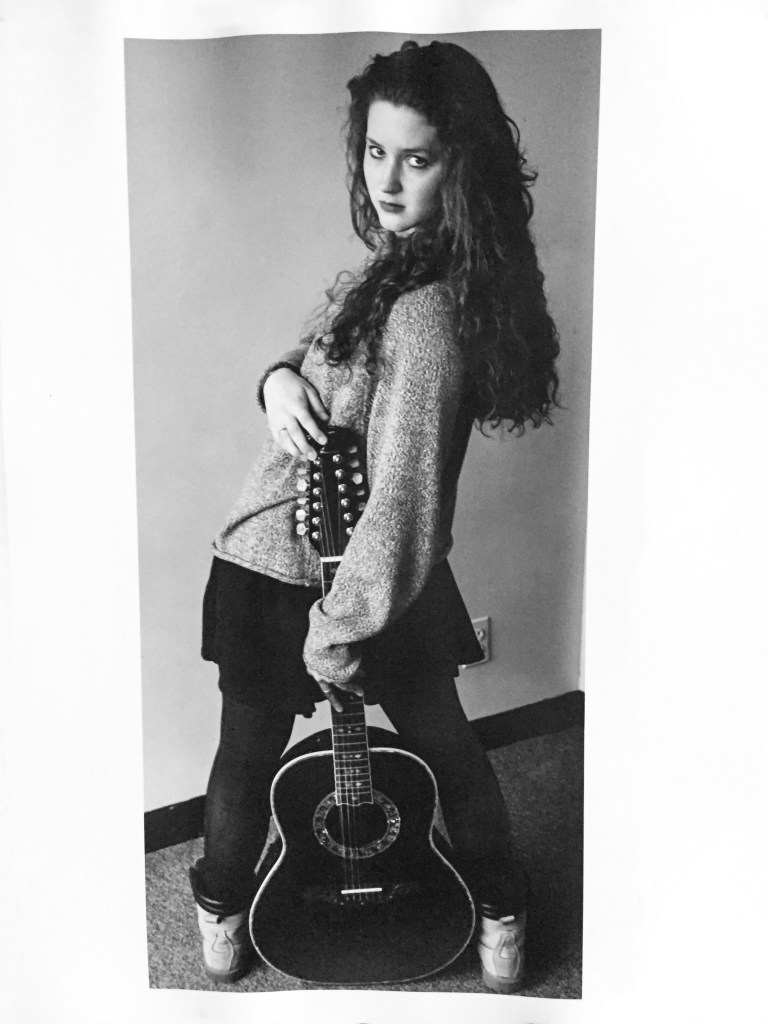
Cynthia Marie Hoffman is the author of four collections of poetry, most recently the OCD memoir in prose poems Exploding Head. Essays have appeared in TIME, The Sun, and Lit Hub. She is currently at work on a prose memoir in 10 songs on coming of age in the early 90s as a guitar-toting Gen X metalhead with then-undiagnosed OCD. Her favorite pizza topping is cheese, extra cheese. Cynthia lives in Madison, WI. www.cynthiamariehoffman.com

